

Work-family balance rarely comes from working less. For most parents it comes from carrying less of the coordination: who is picking up, which meeting collides with the school event, what changed overnight. Our assistant Elle, from Momentality, pulls your calendars, emails and school schedules into one place and flags conflicts before they reach your workday. Below is what drives the strain and a routine that works with or without extra tools.
TL;DR
- Work-family conflict is about time, stress and mental load, and it is linked to burnout and poor sleep.
- The biggest fix is one shared calendar everyone uses, plus one short weekly check-in.
- Move whole tasks between adults instead of splitting them, so one person stops being the default planner.
- Set a hard stop for work notifications to protect family time.
- Elle watches your connected sources, catches conflicts and adjusts schedules so you do not have to prompt it.
Table of Contents
- Why balance feels so hard
- Find what is actually causing the chaos
- A weekly system that holds up
- Support for different family setups
- Where Elle fits
- FAQ
- Sources
Why balance feels so hard
Researchers describe work-family balance as being equally involved and satisfied in both roles with minimal conflict. Conflict shows up in three forms: work takes too much time, work stress drains you at home, or work habits clash with family life, as described on Singapore's Family Assist.
The cost is real. A 2021 public-health commentary links work-to-family conflict to burnout, anxiety, depression and poorer sleep. A 2025 study of 818 working parents found conflict was tied to more parenting burnout and a weaker parent-child relationship. The American Psychological Association notes that parental work stress most affects employed mothers expected to do most of the household work, who lose the equivalent of a night's sleep each week.
That is why the goal is not a perfect 50/50 day. It is fewer collisions and a fairer split of the invisible planning.
Find what is actually causing the chaos
Before changing anything, spend one week tracking where time goes. Cornell Cooperative Extension suggests logging paid work, housework, childcare, travel and leisure, then listing stressors and rating how much control you have over each. Most parents find the same culprits: last-minute changes, events no one else knew about, and one person remembering everything.
If last-minute changes are your daily trouble, our playbook for schedule changes walks through handling them.
A weekly system that holds up
1. One shared calendar
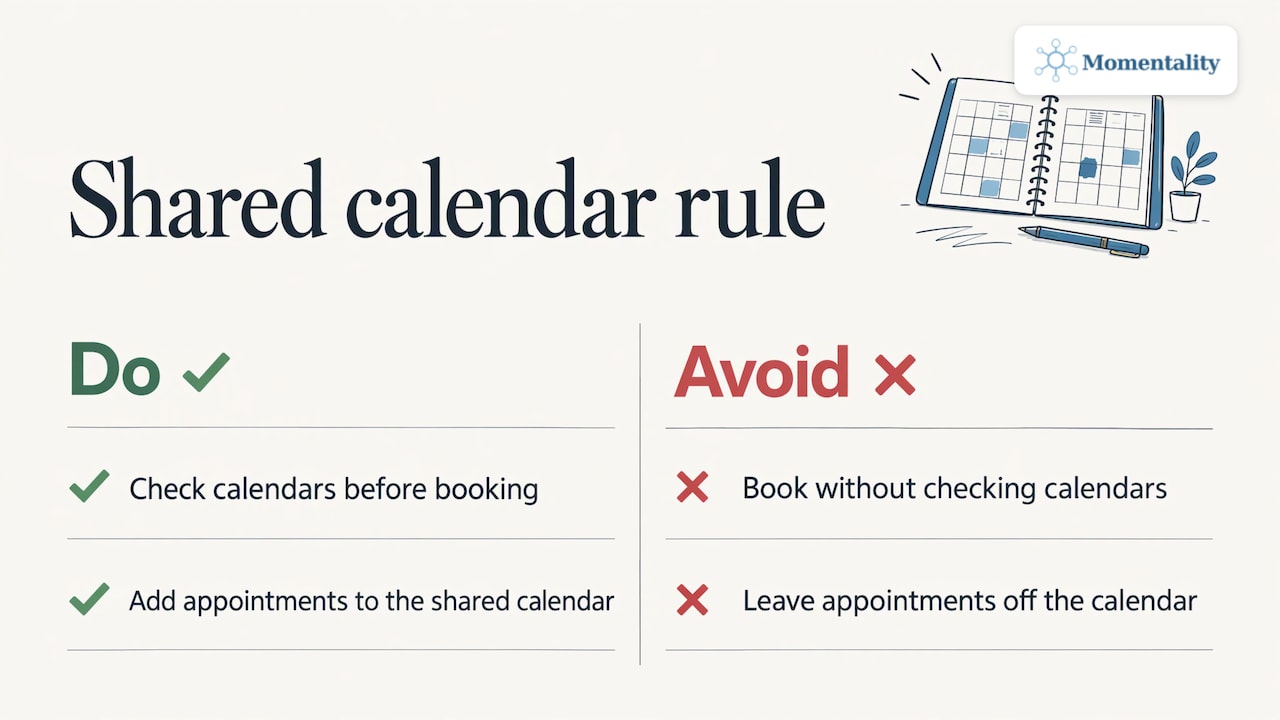
In a German study of 25 parents, the most important coordination tool was a family calendar. Parents checked each other's calendars before booking anything, and noted that appointments not in the calendar "can't be taken into account". Make the rule simple: if it is not on the shared calendar, it is not happening. Our guide to keeping appointments in one place shows how to set this up.
2. One planner, one weekly check-in
A study of 28 households across five countries found families named an informal "boundary governor" who kept the master timetable, and that they aligned schedules, for example one parent covering mornings and the other afternoons. Add a 20-minute weekly check-in covering the next two weeks: who drives, who stays home when a child is sick, what is coming up.
3. Move whole tasks, not pieces
Hand over an entire job, such as noticing, planning, doing and following up on dentist visits, instead of asking for help with a piece. The German study found that clear responsibility for tasks relieved mothers of mental responsibility. For routines, see how to build a chore schedule that lasts and run a household without carrying it all.
4. Draw a line around work
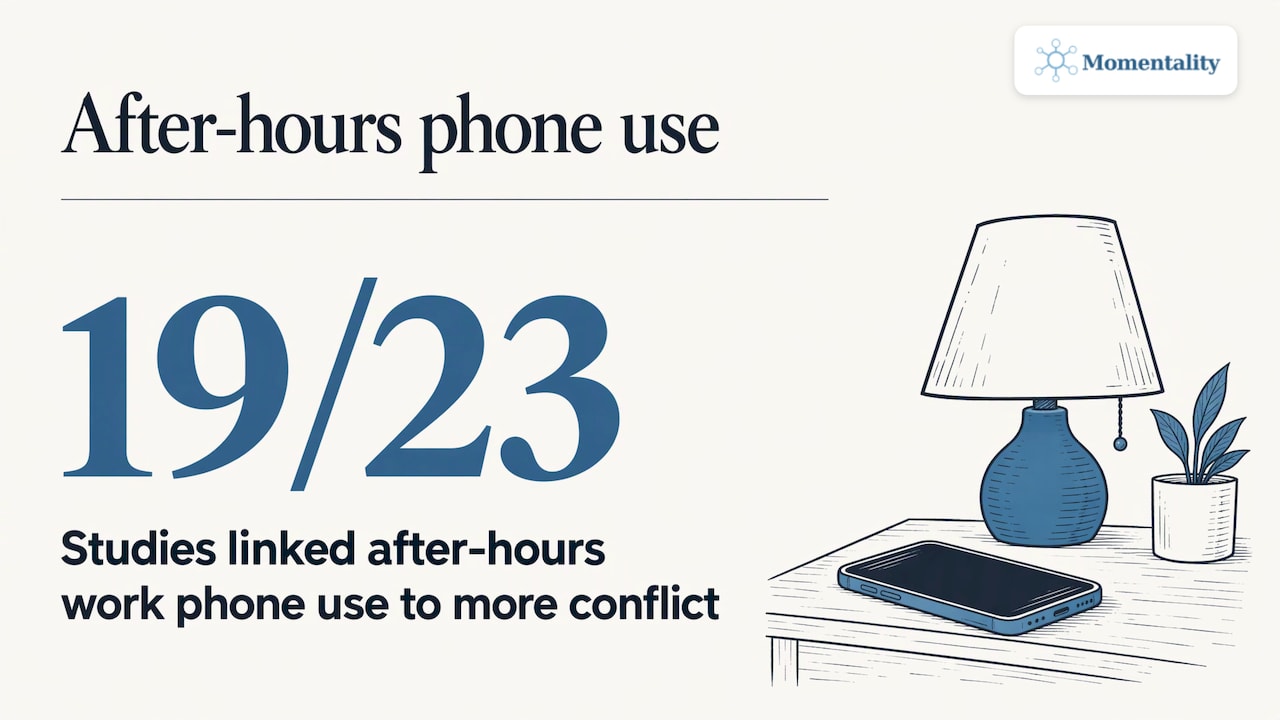
Spillover is often just one more email. Family Assist suggests turning off work notifications at a set time, using your commute or a change of clothes as a switch, and putting the laptop out of sight if you work from home. A 2024 review found that work-related phone use after hours was linked to more work-life conflict in 19 of 23 studies.
Digital tools can help you hold these lines; this routine for busy professionals is one place to start.
Support for different family setups
Informal support counts. A 2020 review found that support from people at home and work is consistently tied to better work-family experiences, while formal policies show weaker evidence.
- Single and divorced parents: a clear handoff calendar prevents missed pickups. See our shared custody calendar guide.
- Military and solo-parenting stretches: one person holding every detail is exactly the pattern to break, so share the schedule with a trusted adult nearby.
- Grandparents: give them a view of the schedule so they can step in without a phone tree. Read how to make grandparent childcare run smoothly.
- Conference days: plan your workday around them early with this scheduling guide for working parents.
For the stress itself, see calm tools for moms, or a simple weekly time system.
Where Elle fits
The routine above works best when the shared calendar stays current without one person typing everything in. Elle connects your calendars, emails, and school and sports schedules into a single interface, sends reminders and a contextual morning brief, and catches conflicts and adjusts schedules proactively instead of waiting for a prompt.

Schedules can be shared with partners, grandparents, caregivers or separated parents, who can follow along without paying, while privacy controls stay in your hands. You can join as a Founding Member to get started.
FAQ
What is the quickest way to improve work-family balance?
Start with one shared calendar and one weekly 20-minute check-in. Those two habits cut missed handoffs and surprise conflicts more than any change to your hours.
How do I balance work and family life as a single parent?
Keep every commitment in a single calendar, name backup adults for sick days, and let trusted family follow the schedule. Fewer decisions made on the fly means less stress.
Does work-life balance mean splitting everything 50/50?
No. It means each task has a clear owner and nobody carries the planning alone. Move whole tasks between adults rather than dividing each one.
When should I seek help for ongoing stress?
If stress is affecting your sleep, mood or health for weeks, talk with your doctor or a licensed mental health professional.
Sources
- Work-life balance: managing the interface between family and working life (OSHwiki)
- When Work Stress Affects Your Family (Family Assist)
- Work-family conflict is a public health concern (PMC)
- Parents' work-family conflict and parent-child relationship (PMC)
- APA report on public policy, work, and families
- Cornell Cooperative Extension: Balancing Work and Family
- Practicable strategies parents can apply in daily life (PMC)
- Who moved my boundary? (PMC)
- Work-related smartphone use during off-job hours (PLOS Digital Health)
- Formal and Informal Supports for Managing Work and Family