
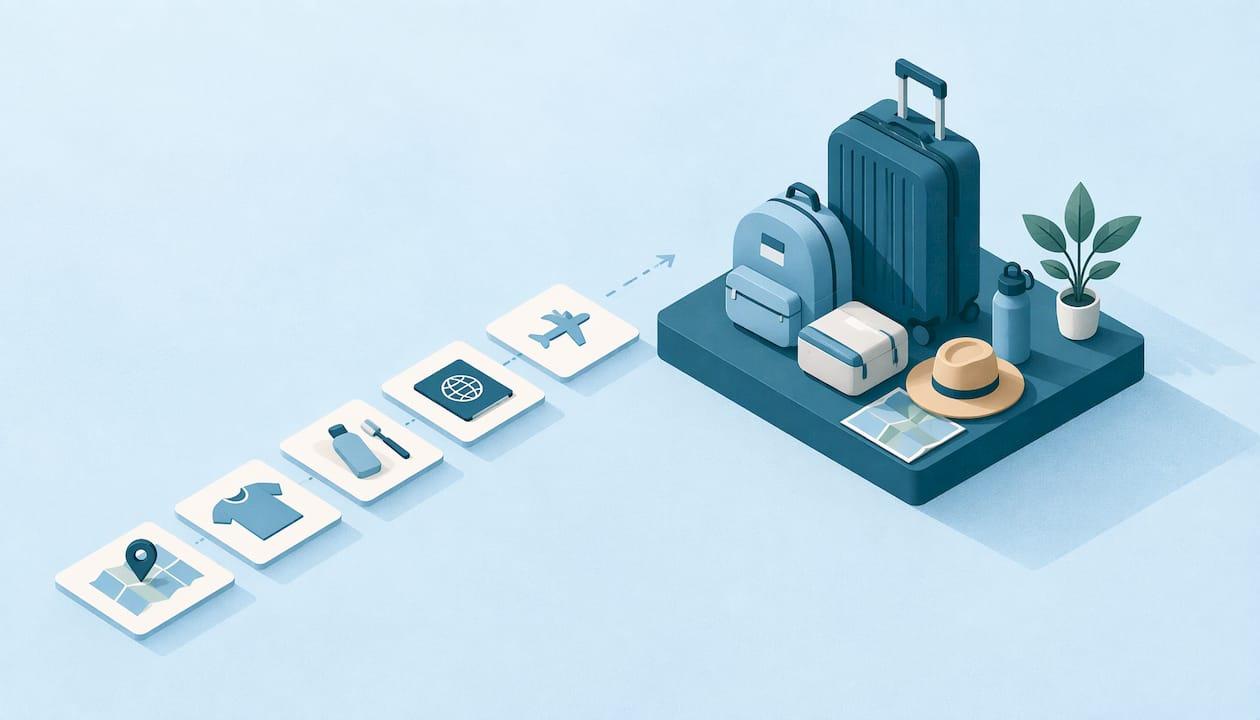
A good family travel checklist does more than list socks and sunscreen. It splits the trip into three jobs: plan (dates, bookings, who does what), pack (one list per person, sorted by purpose) and leave (home, documents, carry-on). Most trips go wrong in the first and third jobs, and those usually land on one parent. Put every task in one shared place, and the packing takes care of itself.
This guide is short on purpose. Use it as a working list, from the first date you pick to the moment you lock the door.
TL;DR
- Start with fixed constraints (work, school, custody, passports, medical needs), then pick dates and destination.
- Build one master family list plus a short personal list per traveler, grouped by purpose.
- Make the carry-on a 24-hour survival kit: documents, medicines, a spare outfit per child, snacks, chargers.
- Plan one main activity a day and protect meals, naps and rest.
- Keep trip details, bookings and tasks in one shared place so partners, grandparents and co-parents see the same plan.
Table of Contents
- Step 1: Plan around your real calendar
- Step 2: Build the packing list the smart way
- Step 3: Adjust by age and trip type
- Step 4: Health and safety checks before you go
- Step 5: Build an itinerary your kids can survive
- Step 6: Before you leave the house
- Where the checklist usually breaks
- Try Elle for your next trip
- FAQ
- Sources
Step 1: Plan around your real calendar
Start with what cannot move. One family planning guide suggests collecting fixed constraints from every household first: school calendars, passport validity, dietary and medical needs, mobility needs, sleep schedules and the longest travel day the group can handle. Only then rank the top three things you want from the trip and shortlist destinations that fit.
If your trip involves grandparents or another household, begin early. A Southern Living guide to multigenerational trips advises planning up to a year or more ahead to coordinate work, school and custody schedules. AARP's group travel guide adds that you should lock dates as soon as school calendars are out.
For a deeper walk-through of the early decisions, see our step-by-step family holiday planning system.
Planning checklist
- Check every traveler's passport or ID validity.
- Confirm time off at work, and any school or custody dates.
- Decide who books flights, lodging and activities.
- Choose bookings you can cancel or change when you can.
- Share dates and addresses with everyone who helps at home or joins the trip.
Step 2: Build the packing list the smart way
Start from four facts: destination, weather, where you are staying and how long. A family packing guide recommends one master list for shared items plus a short list per traveler, grouped by purpose: documents, carry-on, clothing, toiletries, health, sleep, food and destination gear.
Save the list. Next trip, you edit instead of rewriting.
Documents (one adult carries them)
- Passports or IDs, visas and tickets
- Lodging confirmations and an itinerary with addresses
- Insurance details and emergency contacts
- Driver's license, plus any car-rental paperwork
- Digital copies saved offline and a paper set kept separately
A pre-travel checklist also suggests photographing valuables and keeping both physical and digital copies of key documents.
The carry-on: your 24-hour kit
Assume checked bags can arrive late. The carry-on should cover the family for a day:
- A full change of clothes per child and a spare top per adult
- All medications, in the original packaging
- Diapers and wipes if needed, plus extra
- Snacks, refillable water bottles and chargers
- A comfort item and downloaded entertainment
Pack mess-free snacks and a surprise toy or two, as First 5 California suggests.
Clothing, toiletries and health
- Pack outfits by day, not by "just in case." Add one spare per child for spills.
- Give each child a packing cube or small bag so a missing sock is easy to spot.
- Check whether your lodging has laundry. One wash mid-trip often replaces a whole extra suitcase of clothes.
- Bring a small first-aid kit, any regular prescriptions, fever reducer and a thermometer. AARP also suggests carrying familiar foods in case children will not eat local ones.
Step 3: Adjust by age and trip type
| Age | Add to the list |
|---|---|
| Babies | Feeding supplies, diapers, spare outfits, a comforter, medicines within reach |
| Toddlers | Extra snacks, a spill-proof cup, quiet activities, sun protection |
| School age | A labeled day bag, activity clothing, allergy supplies, a laundry bag |
| Teens | Phone, charger and power bank, toiletries, an agreed plan for valuables |
These come from the same age-based family packing guide. It also notes that by the pre-teen years, children can pack from their own list, which makes them more invested in remembering things.
Trip type changes the list as well. Beach trips need sun protection per person and a waterproof pouch. City breaks need comfortable shoes and offline maps. Camping needs a full equipment check before you leave, because one missing tent pole can derail the trip.

Step 4: Health and safety checks before you go
This is where a checklist earns its place.
International trips. The American Academy of Pediatrics' HealthyChildren.org advises asking your pediatrician about extra vaccines or preventive medicines, making sure routine vaccinations are current, and arranging the visit 4 to 6 weeks before you go. The CDC's travel health pages list recommendations by destination.
By car.
- Use the right car seat every time. Children ride rear-facing as long as possible, then forward-facing, then in a booster until the seat belt fits properly.
- Children under 13 ride in the back seat.
- Never place a rear-facing seat in front of an active airbag.
- Plan a break about every two hours, and never leave a child alone in a car.
By air.
- Allow extra time at security and dress children in layers that are easy to remove.
- Gate-check strollers.
- Confirm the airline's car-seat policy.
- Talk to your pediatrician before flying with an infant who has heart or lung problems, or within two weeks of an ear infection. First 5 California gives the same ear-infection advice.
Step 5: Build an itinerary your kids can survive
The best kids' itinerary has fewer things in it. Try this shape:
- Morning: the one main outing, while everyone is rested.
- Midday: pool, lunch or a nap.
- Late afternoon: something gentle.
- Evening: dinner as the time to regroup.
Protect routines. PBS KIDS for Parents suggests keeping some daily routines intact, planning around usual nap and meal times, and shifting nap and bedtimes gradually before a time-zone change.
For each main block, write three lines: the priority, an option if energy remains and a fallback that is the simplest version. TripStoryKit's planning guide also suggests deciding in advance what to drop first when the day runs long: secondary stops go before meals and travel time.
With several adults along, agree up front what everyone does together and when people can opt out. A clinical social worker quoted by Southern Living says clear expectations make it easier when someone steps away.
Step 6: Before you leave the house
- Check baggage rules and check in online.
- Download tickets, maps and entertainment for offline use.
- Charge devices and pack power banks.
- Pack medicines that need the fridge in last.
- Secure the home, and tell whoever is watching it or the pets where everything is.
- Put your last-minute items (phones, chargers, soft toys) on a separate short list.
Where the checklist usually breaks
The packing list rarely fails. The coordination does. The flight confirmation sits in one email, the lodging address in another, the school's last-day notice in a third, and the grandparent picking up the dog needs all of it. Add a co-parent or a partner who travels separately, and one parent ends up holding every thread.
That is the part we built Momentality for. Elle, our AI assistant, brings calendars, emails and school schedules into a single interface and reminds you of what matters without constant input. Elle catches conflicts, for example a trip day that collides with a school event, and can adjust schedules automatically. Schedules can be shared with grandparents, caregivers or separated parents without making them pay for an account.
A few ways families use this around travel:
- A contextual morning brief on departure day.
- Location-based reminders that nudge you when you reach the place you need them, such as the pharmacy.
- A single shared view for grandparents helping with the kids.
- A shared custody calendar so travel dates do not collide with the other household's plans.
If plans shift at the last minute, our playbook for schedule changes helps.
Try Elle for your next trip
Founding Member access is open for families who want Elle handling the logistics so they can enjoy the trip. You can see what it includes on the Momentality features page.

Join as a Founding Member and keep your family's trip tasks, calendars and contacts in one place.
FAQ
How far ahead should I start a family travel checklist?
Start planning as soon as school and work calendars are available. For trips involving several households or custody schedules, Southern Living suggests a year or more ahead. Start packing lists a week before departure, not the night before.
What belongs in a family carry-on?
Documents, all medications, a full change of clothes per child, a spare top per adult, diapers and wipes if needed, snacks, water bottles, chargers and a comfort item. Think of it as the kit that gets you through 24 hours if checked bags are delayed.
How do I plan a travel itinerary with kids?
Schedule one main activity a day, ideally in the morning. Leave room for meals, naps and free time, and write a fallback version of each plan. When the day runs long, drop secondary stops first.
When should I see the pediatrician before an international trip?
HealthyChildren.org recommends a visit 4 to 6 weeks before you leave, to review vaccines and any preventive medicine your destination calls for.
Sources
- HealthyChildren.org: Tips for Safe & Stress-Free Family Travel
- First 5 California: Tips for Traveling Safely With Your Child
- AARP: Smart Guide to Group Travel
- Southern Living: 6 Tips For Planning A Multigenerational Vacation
- PBS KIDS for Parents: Traveling With Children
- HauteBlack: How to Plan a Family Vacation That Actually Works
- Holiday World: Family Holiday Packing Checklist by Age
- TripStoryKit: Plan a Family Travel Day Around Your Child's Energy
- Post Office: Holiday packing and pre-travel checklist