
A family meal planning schedule works when it starts with your calendar, not with recipes. Check who is home, who is late and which nights have practice, then match each dinner to the time you really have. Below is a short routine you can repeat every week, and where Elle, the AI assistant in Momentality, takes the calendar part off your plate.
TL;DR
- Plan around the week's conflicts first: late work, practices, appointments.
- Give each night a theme or a cooking level so only 3 or 4 dinners need new ideas.
- Pick one day to plan, shop and prep, and post the plan where everyone sees it.
- Cook once, eat twice, and keep a backup meal for the night it all falls apart.
- Store prepped food within safe refrigerator and freezer times.
Table of Contents
- Start with the calendar, not the recipes
- Sort nights by how much time you have
- Use theme nights so you decide less
- Pick one planning day and one prep window
- Cook once, eat twice
- Share the plan and the work
- Store prepped food safely
- Let Elle keep the plan in step with the week
- FAQ
- Sources
Start with the calendar, not the recipes
The most common reason a meal plan fails is that it ignores the week it has to live in. The University of Minnesota's guide says to check the family calendar to make sure you have time to cook and that people will be home to eat. Central Ohio Primary Care suggests planning for known weekly conflicts first, such as late work, soccer practice or doctor's appointments.
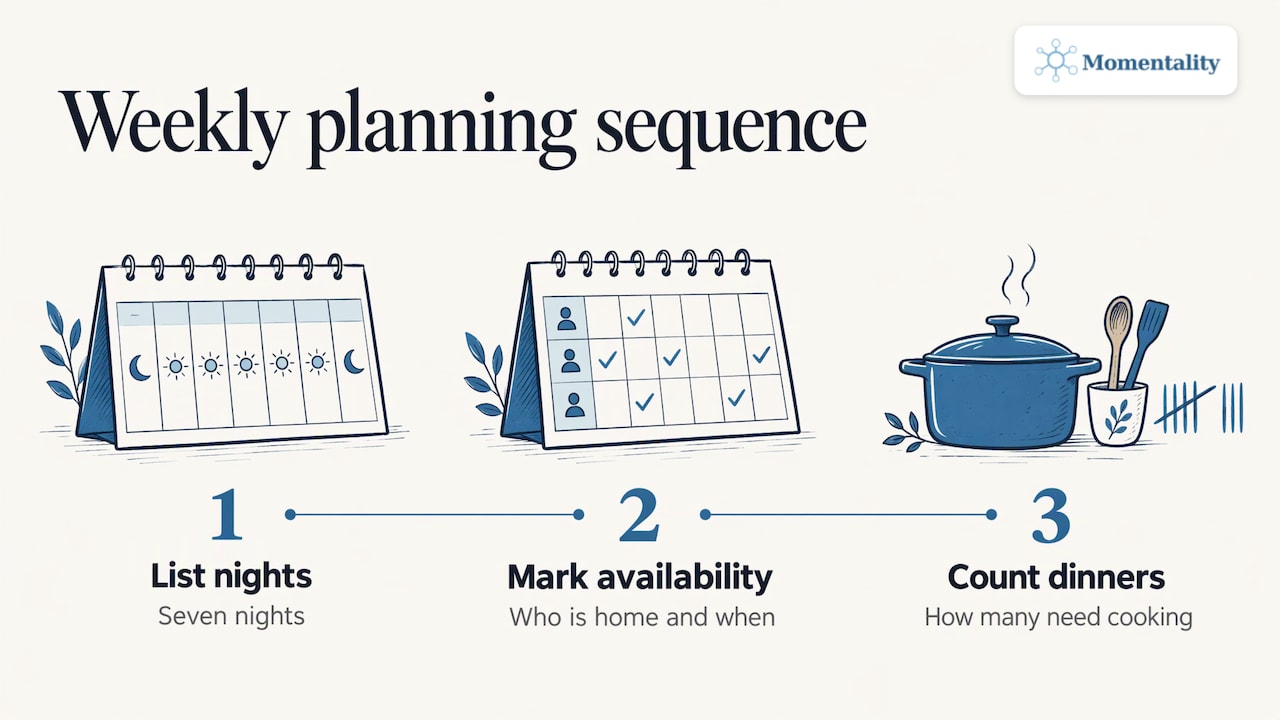
A quick way to do it: list the seven nights, mark each one with who is home and when, then count how many dinners you actually need to cook. A Texas Children's dietitian recommends exactly this first step: count the meals the family needs based on work and personal schedules.
This is the step that eats the most mental energy, because the information is scattered across work calendars, school emails and sports apps. Elle pulls calendars, emails and school and sports schedules into one place and catches conflicts, so you see the week before you plan the menu. If you want the wider system behind that, see our guide to keeping track of family appointments in one place.
Sort nights by how much time you have
The Family Dinner Project's planner sorts meals into two types: "CAN COOK" nights with 30 or more minutes, and "LOW COOK" nights with 15 to 30 minutes. Label each night, then drop in a meal that matches.
A sample week for a working parent:
| Night | Situation | Meal type |
|---|---|---|
| Monday | Home by 5:30 | Easy pasta night |
| Tuesday | Practice until 6 | Low cook: tacos, cook extra meat |
| Wednesday | Late meeting | Leftovers from Tuesday |
| Thursday | Open evening | Can cook: sheet pan chicken |
| Friday | Tired | Pizza or breakfast for dinner |
| Saturday | Flexible | Grill night, kids help |
| Sunday | Prep day | Slow cooker meal plus next week's prep |
The San Diego Family planning guide adds a useful rule: don't plan hour-long dinners for blocks that are already booked, such as 3 to 6 p.m.
Use theme nights so you decide less
Fixed categories mean you only invent a few dinners a week. One home-cooking blogger recommends assigning a category to each night, such as pizza, kid-food, leftovers and grilling, so only 3 to 4 dinners need new ideas. Utah State Extension suggests theme nights like Taco Tuesday and a menu cycle of two to four weeks that repeats.
A practical version: write down 8 to 10 meals your family already eats without complaint. That is your starter list. Rotate it on a two-week cycle and swap in one new recipe when you have the energy. Cooking up a repeat plan also helps in a recurring routine for the rest of the house, since the same logic applies to chores.
Pick one planning day and one prep window
Harvard's Nutrition Source recommends choosing one day a week to plan the menu and grocery list, shop and prep. Start with the longest-cooking foods and use that time to do other prep. North Dakota State University suggests setting aside one chunk of time, maybe Sunday afternoon, as "cook-all" time.
A 20-minute version of the routine:
- Look at the week's calendar and mark each night.
- Pick meals from your starter list.
- Check the fridge and pantry before writing the grocery list.
- Shop once. Colorado State Extension notes that a weekly plan saves time by avoiding multiple store trips.
- Prep what you can: chop onions for the week, or brown meat for two meals while the pan is hot.
ParentCo describes a weekly routine of about 20 to 25 minutes built on a list of tried-and-loved recipes and a template with staples already on the grocery list.
Cook once, eat twice
Leftovers are the easiest way to cover a busy night. The University of Minnesota suggests roasting a chicken one night and making a casserole with the leftovers. Clemson's extension recommends at least one "planned-over" meal each week.
Two more habits help:
- Start with a sauce. Chef Jen Welper says beginning with a sauce such as teriyaki lets you reuse ingredients across the week. Reusing ingredients also makes the weekly list shorter. A weekly plan that cross-uses ingredients is easier to shop for and cook.
- Plan to fail. Keep a backup such as frozen pizza or canned soup, so a late practice does not mean a drive-through run.
Share the plan and the work
Post the plan on the refrigerator. Colorado State Extension's Sheila Gains notes that this lets family members help, for example by peeling carrots or washing greens before you get home. Clemson suggests letting children help plan and prepare one meal a week, which makes them more likely to try new foods.

In one ParentCo routine, one partner chooses meals and builds the list while the other checks it and shops, and cooking rotates by who has capacity. The same idea works for single parents, co-parents and grandparents: give each person one clear job. When the schedule is shared across households, a shared custody calendar keeps everyone on the same page about who has the kids on which night.
Store prepped food safely
Harvard's storage chart gives these refrigerator times at 40°F or lower:
| Food | Refrigerator | Freezer |
|---|---|---|
| Cooked ground poultry or beef | 1 to 2 days | 3 to 6 months |
| Cooked whole meats, fish, soups, stews | 3 to 4 days | Soups and stews 2 to 3 months |
| Cooked beans and hummus | 5 days | n/a |
| Hard-boiled eggs, chopped vegetables | 1 week | Blanched vegetables 8 to 12 months |
Label frozen portions with the date. For freezer meals, North Dakota State suggests undercooking starchy foods such as rice and pasta, and avoiding boiled eggs, sour cream and mayonnaise.
Let Elle keep the plan in step with the week
A meal plan is only as good as the schedule under it, and schedules change. Elle monitors your connected calendars, emails and school schedules, anticipates conflicts and adjusts automatically, and a contextual morning brief tells you what the day holds. When practice moves or a meeting runs late, you see it before dinner is on the stove. Invited partners, grandparents and caregivers can follow the schedule without paying. Join as a Founding Member or see what Elle does.

When plans change at the last minute, our playbook for schedule changes shows how to reshuffle the week. For the bigger picture, read about household management systems.
FAQ
How far ahead should I plan family meals?
One week is enough to start. Many extension guides suggest a menu that repeats on a two to four week cycle, which cuts planning to almost nothing once it is set.
How many dinners do I really need to plan?
Fewer than seven. Count the nights everyone is home and able to cook, then cover the rest with leftovers and a backup meal.
What if my schedule changes midweek?
Swap meals between nights. The University of Minnesota recommends switching meals around to fit schedule changes, so plan on paper or a shared note that is easy to edit.
Can the kids help?
Yes. Start with one meal a week they plan and help make, and small jobs like washing greens before you get home.
Sources
- Meal planning | Real Life, Good Food, University of Minnesota
- Meal Planning for Busy Families | Central Ohio Primary Care
- Texas Children's: Incorporating meal planning into your weekly routine
- The Family Dinner Project: Meal Sorting Planner
- San Diego Family: How to Plan a Month of Meals
- What Lisa Cooks: Meal Planning
- Utah State Extension: Meal Planning 101
- Harvard Nutrition Source: Meal Prep Guide
- North Dakota State University: Family Meal Times, FN1535
- Colorado State University Extension: Meal Planning for Busy Families
- ParentCo: Weekly Meal Planning Routine for a Whole Family
- Clemson HGIC: Planning Meals for a Family
- Mayo Clinic Press: Meal planning 101